Start with one article, not a reading backlog
Vocabulary practice works better when the source is fresh. Choose one article you actually want to understand, then finish the reading before saving words. The goal is not to collect everything; it is to turn one meaningful source into a small review loop.
- Use a news story, essay, newsletter, blog post, or book excerpt.
- Avoid saving every unknown word on the first pass.
- Mark words that change your understanding of the article.
Save reusable words and phrases
A word is worth saving when you expect to meet it again or use it yourself. Good article vocabulary often includes verbs, opinion words, topic phrases, collocations, and connectors that appear across many sources.
- Prefer “reduce congestion” over only “congestion” if the phrase is useful.
- Save words tied to the article topic, but keep general-purpose language too.
- Skip rare terms unless they are central to your goal.
Keep the sentence beside the word
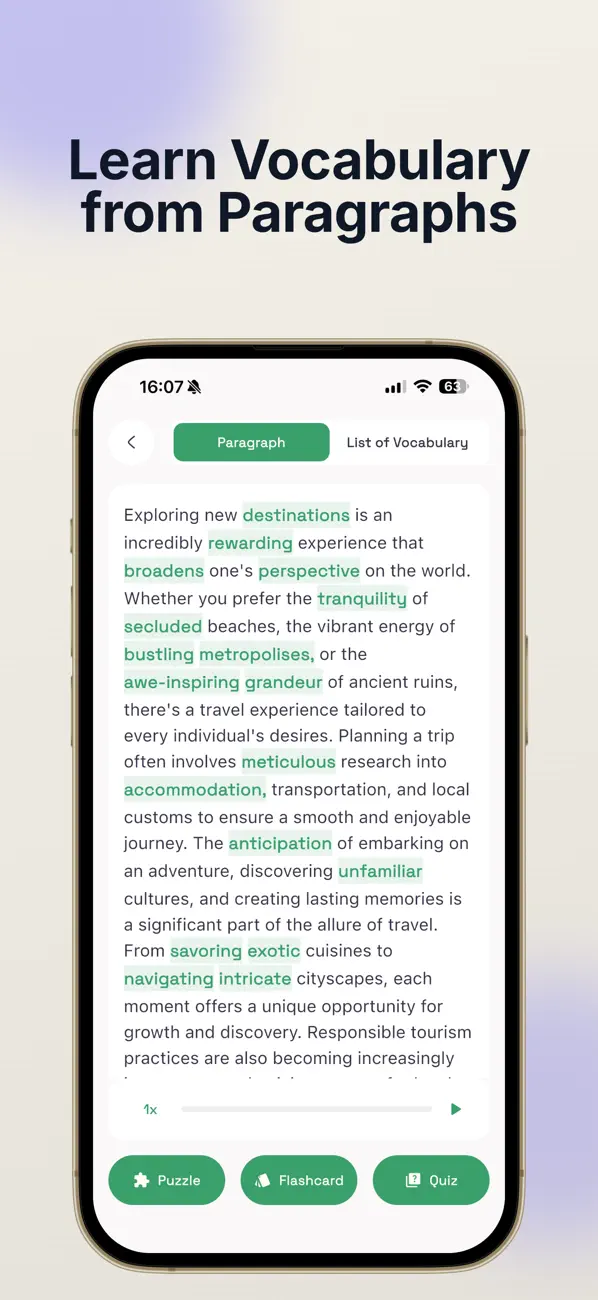
The sentence is what gives a word shape. It shows grammar, tone, topic, and the kind of words that naturally appear nearby. Reviewing a word without its sentence often turns reading vocabulary into a disconnected translation list.
- Keep the original sentence or a short nearby excerpt.
- Add a simple example only after the source sentence makes sense.
- Review how the word behaved in the article, not only its dictionary meaning.
Review the next day before adding more
The common mistake is reading ten articles and reviewing none of them. A better routine is one article, one small vocabulary set, and one short review the next day. Weak words should come back before you add another pile.
- Complete one review session before starting a new large source.
- Let missed words return instead of manually rebuilding the deck.
- Use the article topic to test whether you can recognize the word again.
A simple article routine
Read one article, save five to twelve useful items, review them with context, then revisit the words that slip. That small loop is easier to keep than a giant vocabulary system and still compounds over time.
- Day 1: read and save useful items.
- Day 2: review the saved vocabulary.
- Day 3+: bring weak words back while reading the next source.